
Image: Olu Eletu / Wikimedia Commons (CC0)
A brand name is one of the few assets a small business creates entirely from scratch, and it is surprisingly easy to lose. An owner spends years building recognition, then receives a letter from a company that registered a similar name first. Or they discover they cannot stop a copycat because their own rights were never formalized. Federal trademark registration does not solve every problem, but it gives a business far stronger tools to protect its name, logo, or slogan.
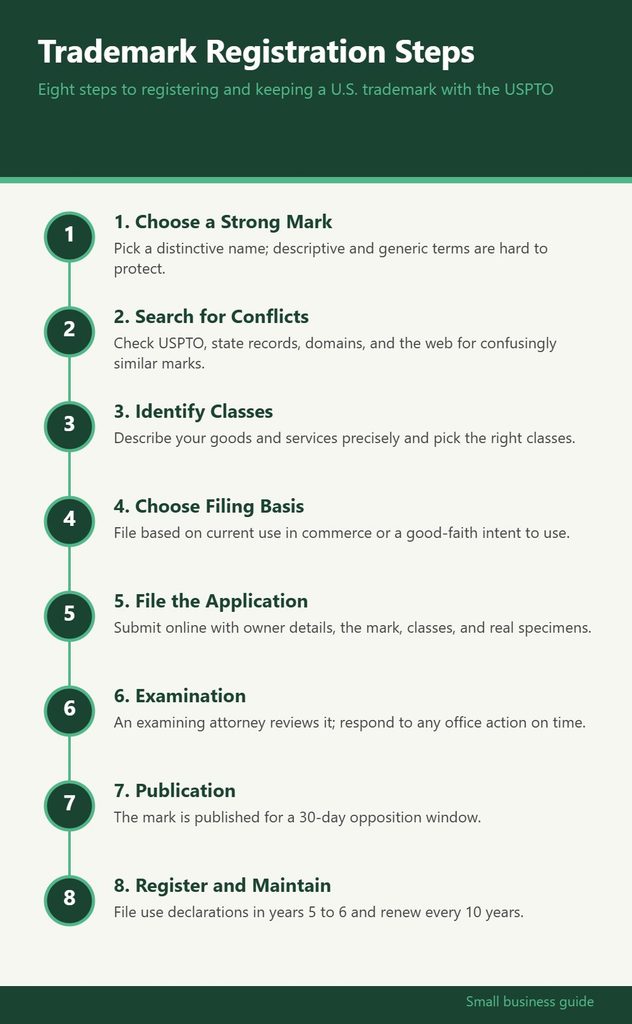
The process through the United States Patent and Trademark Office (USPTO) follows eight broad steps, from choosing a mark that can actually be protected to keeping the registration alive for years afterward. It takes patience, since applications commonly take many months to move through, and the details reward careful preparation. Here is how each step works.
Step 1: Choose a Mark That Can Be Protected
Not every name can be registered, and the strength of a mark is determined largely by how distinctive it is. Trademark law generally sorts marks along a spectrum:
- Fanciful marks are invented words with no prior meaning. They are typically the strongest.
- Arbitrary marks are real words used in an unrelated context, such as a fruit name for a computer company. Also strong.
- Suggestive marks hint at a quality of the product without describing it directly. They are usually registrable.
- Descriptive marks simply describe the product, such as “Fast Plumbing.” They are hard to register unless they have acquired distinctiveness through long, substantial use.
- Generic terms, the common name for the product itself, cannot function as trademarks at all.
Many founders lean toward descriptive names because they explain the business instantly. From a trademark perspective, that is often a weak choice. A more distinctive name may take more marketing effort early on, but it is much easier to protect.
Step 2: Search for Conflicts
The most common reason applications are refused is a likelihood of confusion with an existing mark. That means a mark that is similar in sound, appearance, or meaning, used on related goods or services, in a way that could confuse consumers about who is behind the product. Identical names are not required for a conflict.
Start with the USPTO’s free trademark search system to look for registered and pending marks. Then widen your search: check state trademark databases, business name registries, domain names, social media handles, and general web results. Unregistered businesses can still have common law rights in the areas where they operate, and those rights may limit yours.
A thorough search considers variations: alternative spellings, plurals, phonetic equivalents, and translations. Many owners do a basic search themselves and then pay an attorney for a comprehensive clearance search before investing heavily in branding. GrowBizLab has a practical walkthrough of how to run a preliminary trademark search and read the results, and this blog post is worth a look before you commit to a name.
Step 3: Identify Your Goods, Services, and Classes
A trademark is not registered in the abstract. It is registered for specific goods or services, organized into classes under an international classification system. There are 45 classes in total, with the first 34 covering goods and the remaining 11 covering services. A bakery selling packaged cookies might file in one class for baked goods, while a café serving food on site might use a services class instead, or both.
Your description of goods and services must be accurate and specific. Describing them too broadly can lead to objections, while describing them too narrowly can leave gaps in your protection. The USPTO maintains a searchable list of pre-approved descriptions, often called the ID Manual, which can make your application smoother. Filing fees are charged per class, so think carefully about which classes you genuinely use or plan to use soon.
Step 4: Choose Your Filing Basis
U.S. applications must state a legal basis for filing. The two most common for small businesses are:
- Use in commerce: You are already using the mark to sell goods or services across state lines or in other commerce regulated by Congress. You must provide the date of first use and a specimen showing the mark as customers actually see it, such as a product label, packaging, or a web page where services are offered.
- Intent to use: You have a genuine, good-faith plan to use the mark but have not started yet. This lets you secure an earlier filing date while you prepare to launch. You will need to prove use later, before the registration can be issued, and additional filings and fees apply.
Specimens are a frequent source of trouble. A mockup, a digitally altered image, or a page that does not show how to purchase the product may be rejected. Use real, current materials.
Step 5: File the Application
Applications are filed electronically through the USPTO’s online system. You will provide the owner’s name and address, which should be the business entity if the business owns the brand, a clear drawing of the mark, the goods and services with their classes, the filing basis, and specimens where required. Check the USPTO’s current fee schedule before filing, since fees and application options are updated periodically.
You can file a standard character mark, which protects the words themselves regardless of font or design, or a special form mark, which protects a specific stylized appearance or logo. Many businesses start with a standard character mark for their name because it offers broader protection, and register the logo separately later if needed.
Note that applicants who live or are based outside the United States are generally required to be represented by a U.S.-licensed attorney. Domestic small business owners may file on their own, though many still choose to hire one.
Step 6: Examination and Office Actions
Several months after filing, a USPTO examining attorney reviews the application. They check for conflicts with existing marks, whether the mark is too descriptive, whether the goods and services are properly described, whether the specimen is acceptable, and other legal requirements.
If there are problems, the examiner issues an office action, a letter explaining the issues. Some are minor, such as clarifying a description. Others are substantive, like a likelihood of confusion refusal. You must respond by the deadline stated in the office action, or the application will be abandoned. Substantive refusals often benefit from an attorney’s help, since responses may involve legal arguments and evidence.
Step 7: Publication and the Opposition Period
Once the examiner approves the mark, it is published in the USPTO’s Official Gazette. This opens a 30-day window during which anyone who believes they would be harmed by the registration can file an opposition or request more time to do so. Most applications pass through without challenge, but businesses with similar marks do monitor publications and sometimes object.
If no opposition is filed, a use-based application proceeds to registration. An intent-to-use application instead receives a notice of allowance, after which you must file a statement of use, with specimens, showing that you have started using the mark, within the allowed time frame or approved extensions.
Step 8: Registration and Ongoing Maintenance
When the registration issues, you gain important benefits: a legal presumption that you own the mark nationwide for the listed goods and services, the right to use the registered trademark symbol, the ability to bring an action in federal court, and the option to record the registration with U.S. Customs to help block infringing imports.
Registration is not permanent by default. To keep it alive, owners must file a declaration of continued use between the fifth and sixth years after registration, and then renew every ten years, showing the mark is still in use. Missing these deadlines cancels the registration. Put the dates on your calendar the day the registration arrives.
Enforcement is also your responsibility. The USPTO does not police the market for you. Watch for copycats online and in your industry, and act when you spot infringement, often starting with a cease-and-desist letter. If you want a deeper look at what to do after registration, including monitoring and enforcement basics, GrowBizLab covers trademark maintenance for small businesses; visit this website to read its guides on keeping your brand protected over time.
Federal, State, or Common Law Rights?
It helps to understand what federal registration adds. Simply using a mark in business can create common law rights, but those rights are generally limited to the geographic areas where you actually operate and are harder to prove. State trademark registration is usually cheaper and faster, yet it only covers that state. Federal registration provides nationwide notice of your claim, which is why businesses that sell online or across state lines usually treat it as the main goal, sometimes using a state filing as an interim step.
Watch Out for Trademark Scams
Because application details are public, new applicants often receive official-looking letters and emails asking for payment to “register” the mark in a private directory, monitor it, or renew it early. Many of these come from private companies, not the USPTO, and the services are of little or no value. Official USPTO correspondence about your application generally comes from a uspto.gov email address. When in doubt, check your application status directly on the USPTO website before paying anything.
Common Trademark Mistakes
- Choosing a descriptive name. It may feel safe for marketing but is often difficult to register and enforce.
- Skipping the search. Discovering a conflict after printing packaging and building a website is expensive.
- Filing in the wrong name. If the business owns the brand, the application should usually be filed by the business entity, not the founder personally.
- Weak specimens. Mockups and images that do not show real use in commerce are commonly rejected.
- Missing deadlines. Office action responses, statements of use, and maintenance filings all have strict time limits.
Trademark registration is a slow process, but it is one of the most cost-effective ways to protect the reputation you are building. Choose a distinctive mark, search carefully, describe your goods and services precisely, and keep track of every deadline. Years from now, when your name is worth far more than it is today, you will be glad the groundwork was done properly.