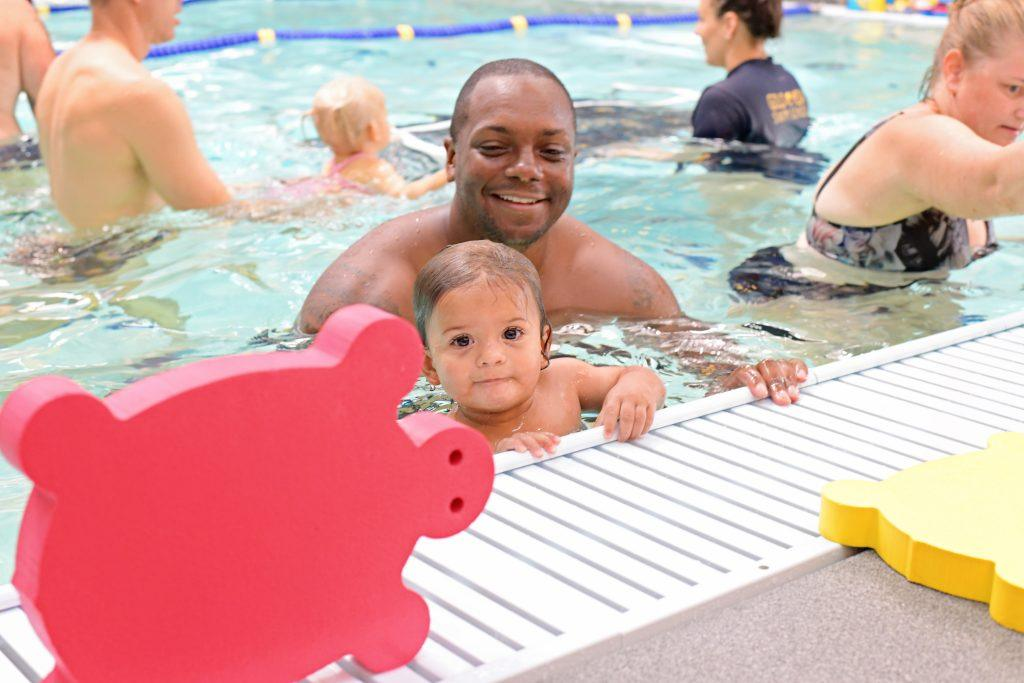
Your baby spends 30 minutes a week in a swim class and the rest of the week doing everything else. That gap is where progress is either won or lost, and closing it does not take a pool. If you searched for baby swim lessons near me, you are already ahead, and a few small habits at home can make those weekly classes stick.
None of this needs fancy gear. Bath time, a sink, a bucket of warm water and a few minutes of your full attention are plenty. The trick is doing a little often, keeping it fun, and never turning it into a drill your baby learns to dread.
Start with bath time
Bath time is the easiest practice session you have, because your baby is already in the water and already used to it. Keep the water and the room warm, and stay within arm’s reach every second, since babies can slip under in very little water.
Pour water gently over your baby’s back and shoulders with a cup, then work up to the head from behind, never straight onto the face. Tell them what is coming first, something like “here comes the water.” Predictable routines help babies relax, and relaxed babies learn faster.
Gold Medal Swim School’s baby swim lessons are built around that same idea, a fun, positive introduction to the water for babies and toddlers from 3 to 36 months. What you do at home simply keeps that feeling going between classes.
Make bubbles a habit
Blowing bubbles is one of the first skills taught in class and one of the easiest to repeat at home. Put your mouth near the water, blow big bubbles, and let your baby watch and copy you. If all they do is splash, that still counts. Do it a few times a week and it becomes part of the routine instead of an event.
Gold Medal starts each lesson with bubble blowing to build air regulation, so doing it at home means your child practices the same skill far more often. A shallow bowl of water on the kitchen table works for toddlers, as long as you stay right beside them. Keep it to a minute or two and stop before they lose interest.
Teach them to wait for you
One of the most useful things a young child can learn is to stop at the water’s edge and wait for an adult. It sounds minor, but it matters more than any kick or stroke. Gold Medal teaches a “Sit, Listen, and Wait” routine at the start of every lesson, and parents tend to notice and appreciate that focus.
Practice it with any water you have: the bathtub, a paddling pool, the edge of a real pool. Have your child sit, wait for your cue, and only then get in with you. Do it every single time until it becomes automatic, because consistency beats perfection here.
Whichever schools swimming programs you are comparing, ask what they want you to practice at home. A good one gives you specific things to repeat, not just a vague “keep it fun.” Gold Medal’s baby swim welcome packet includes a Swim at Home section, which is the kind of thing worth looking for.
Practice turning to the wall
Another skill parents often love in class is learning to turn toward the wall and grab the edge. In a pool, with you in the water and your hands on your baby, face them toward the wall and guide their hands to the edge. Say something cheerful each time they touch it.
Treat this as a safety skill, not a guarantee. No amount of practice makes a baby drown-proof, and an adult within arm’s reach is what actually keeps them safe. Be wary of anyone who tells you otherwise.
Floating and kicking, gently
Floating is more about feeling than technique. Support your baby’s head and back in the bath or pool, keep your hands under them, and let them feel the water holding them up. If they stiffen or fuss, bring them back upright and try again later.
Kicking usually takes care of itself. Hold your baby under the arms facing you and let them splash. Babies kick because it is fun, and that is exactly the point.
Keep it short and drop the pressure
Five minutes a few times a week beats one long Saturday session. Babies get cold and tired quickly, and a cranky baby does not learn much. Stop while they are still laughing.
Skip anything that makes your baby cry or gasp. Old advice about dunking babies to teach breath holding is outdated, and it tends to make kids fear the water instead of respect it. Gold Medal’s approach is to teach respect for the water, not fear, and that is a good rule at home too.
Do not compare your baby to anyone else’s either. One child floats happily on day one and another needs weeks before they trust the water. Both are normal.
Making classes and home practice work together
Missed classes happen, especially with babies who nap on their own schedule. Gold Medal offers makeup vouchers for baby swim that you request through your customer portal and can use within a year, and enrolled baby swim students can request an extra class on the same day through Unlimited Swim when there is space.
That extra time in the water is useful, but it works best when you are consistent at home too. A short bath routine three or four times a week does more than hoping one weekly class will do all the work.
After any water time, dry your baby quickly and dress them warm. Babies lose heat fast, and a baby who finishes shivering will not want to try again.
If you are not sure when your baby is ready to start, or what to practice between lessons, you can reach out to us and ask. A short conversation with the swim school will tell you more than any generic checklist.
Baby swim lessons also work better when a parent knows what the instructor is focusing on. Ask which skill is the priority this month, and pick one small thing to repeat at bath time. A single skill practiced well beats five practiced halfway.
Be realistic about your own comfort in the water too. Babies pick up on a nervous parent quickly, so if you are anxious, take a few deep breaths before you start, and keep your voice calm and your movements slow. Your confidence is half the lesson.
Bring a small towel and a warm layer to the pool, and keep a few simple toys nearby for after class. A cup or a floating toy can turn bath time into a game, which keeps the skills coming without feeling like work.